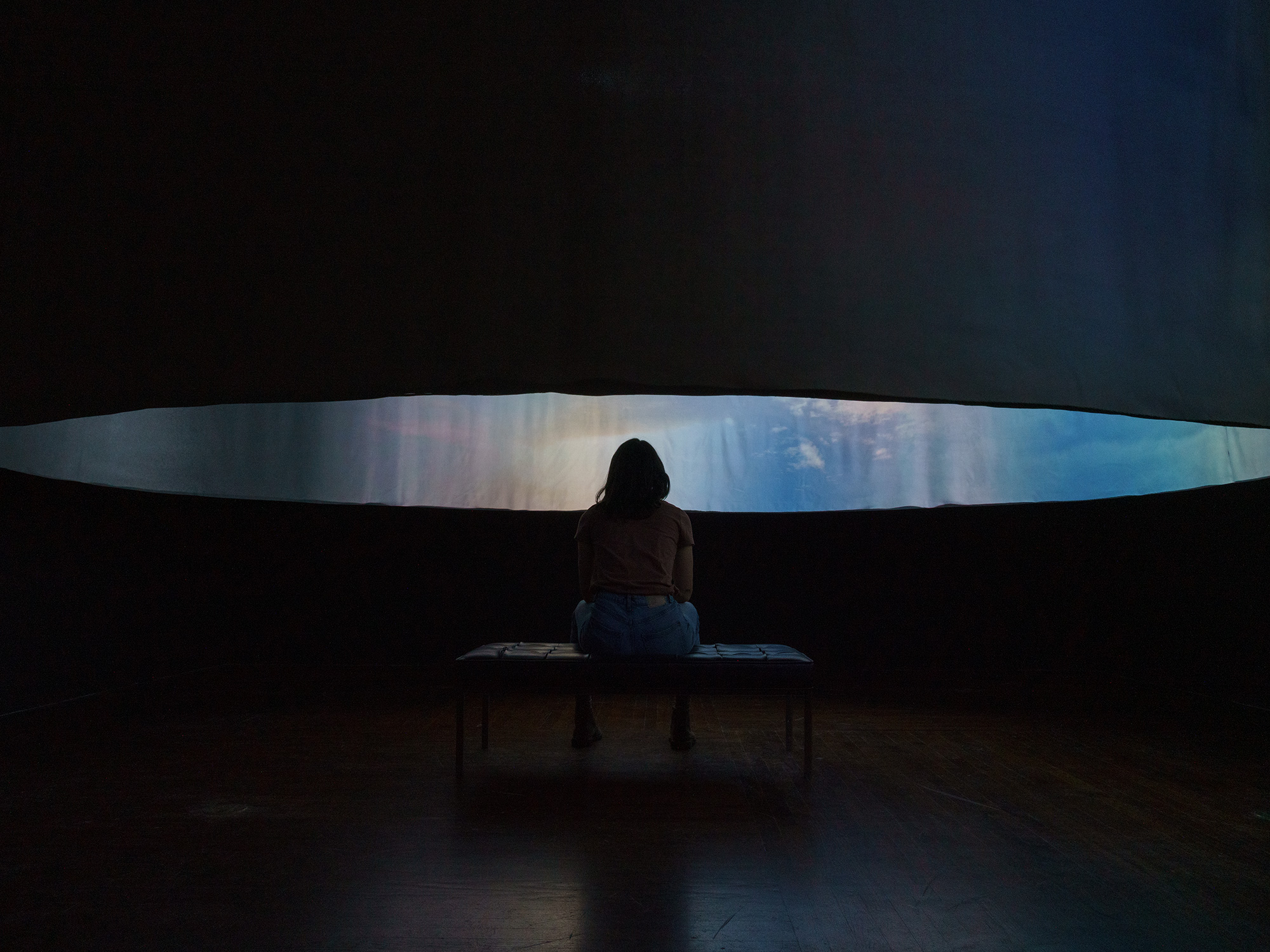
Timing is hard to define when you’re inside it. You usually understand it only in hindsight, once enough distance has passed to see how things lined up. That is how I now think about Constant Dullaart: Onomatopoeia, which I saw at the Utah Museum of Contemporary Art (UMOCA) as part of their Looped video series. It was an exhibition about digital space and presence, but what stayed with me most was how precisely timed the experience felt, both then and years later.
The exhibition centered on Dullaart’s YouTube on the Floor II (2012), a video installation that projected internet content across the gallery floor and walls. Instead of standing back and watching, visitors had to move through it. Familiar digital material suddenly demanded physical attention. Where you stepped mattered. Where you looked mattered. The work slowed you down and asked you to notice the act of engagement itself.
Timing Inside the Exhibit
When I visited the exhibition, the gallery was nearly empty. The main room was large, filled with projector screens casting light across the space. There were only two of us there, myself and Mike Moon, bassist for the band Quiet Oaks. The lack of other people changed everything. Without a crowd, the exhibition did not feel performative or hurried. We had time to sit with it, to wander, to pay attention.
An onomatopoeia is a word that sounds like the thing it describes. It does not interpret or explain. It echoes. Dullaart’s exhibition did something similar. It did not comment on digital culture from a distance. It recreated the sensation of moving through it.
Part of the installation included karaoke machines. Singing to each other in that space made the contrast between digital chatter and human touch impossible to miss. The videos were endless and anonymous. The voices were live, imperfect, and fleeting.
That night became one of those moments that quietly stays with you. Not dramatic, not cinematic in an obvious way, just deeply present. Over the years, both Mike and I reminisced on our shared experience often.
Romantic Timing
Art has always been a shared framework in our lives. Mike’s work centers on rhythm and atmosphere, whether through music, cooking, or managing live events where timing is everything. My work focuses on visual storytelling, dark romance, and marketing, where timing determines whether a message resonates or disappears entirely.
Years later, after Mike’s band finished touring and returned to Utah during Covid, and after I had moved through a difficult divorce, our timing finally aligned again. Friends have referred to our story as an example of the invisible string theory, the idea that certain connections stretch quietly across time until the moment is right.
What stood out to me was not the romance of it, but the clarity. We were not the same people we had been a decade earlier, but we reconnected instantly as if no time had passed. The timing was finally right.
Why Onomatopoeia Still Resonates
Looking back, Onomatopoeia feels ahead of its time. Dullaart was exploring how mediated environments influence attention and behavior long before conversations about AI and algorithmic culture became mainstream. The exhibition was less about technology itself and more about how timing and context shape experience.
Today, artificial intelligence plays a significant role in how content is created, distributed, and consumed. Speed is rewarded. Volume is rewarded. Timing, however, still belongs to humans. Knowing when to speak, when to pause, and when to let something unfold cannot be automated.
That is where the exhibition continues to inform how I think about my professional work.
Timing as a Creative and Marketing Skill
In art, timing determines whether a piece feels rushed or considered. In music, it determines groove, tension, and release. In writing, it shapes pacing and emotional impact. In marketing, timing can be the difference between relevance and noise.
Experience marketing is often framed as innovation or engagement, but at its core, it is about timing. When does someone encounter a message? What else is competing for their attention? Is there room for curiosity, or are we demanding too much, too fast?
Onomatopoeia worked because it respected timing. It asked visitors to slow down. It allowed space for participation without pressure. It trusted the audience to find meaning on their own terms.
Why Timing Matters
That night at UMOCA taught me something I return to often. Great experiences are not always loud or immediate. They land because the timing is right and because they make room for people to be present.
As a marketing manager with a creative background, I think often about how to design work that respects attention rather than competes for it. In an AI-driven world optimized for speed and scale, timing becomes a differentiator. When to launch. When to listen. When to let something breathe.
In that way, Onomatopoeia remains one of the most memorable exhibitions I have experienced. Like the word itself, it did not over-explain. The the moments that followed, in art, in work, and in life, have taught me how much timing truly matters.
I hope you’ll check out UMOCA soon!
xoxo,
Michaela Rae
