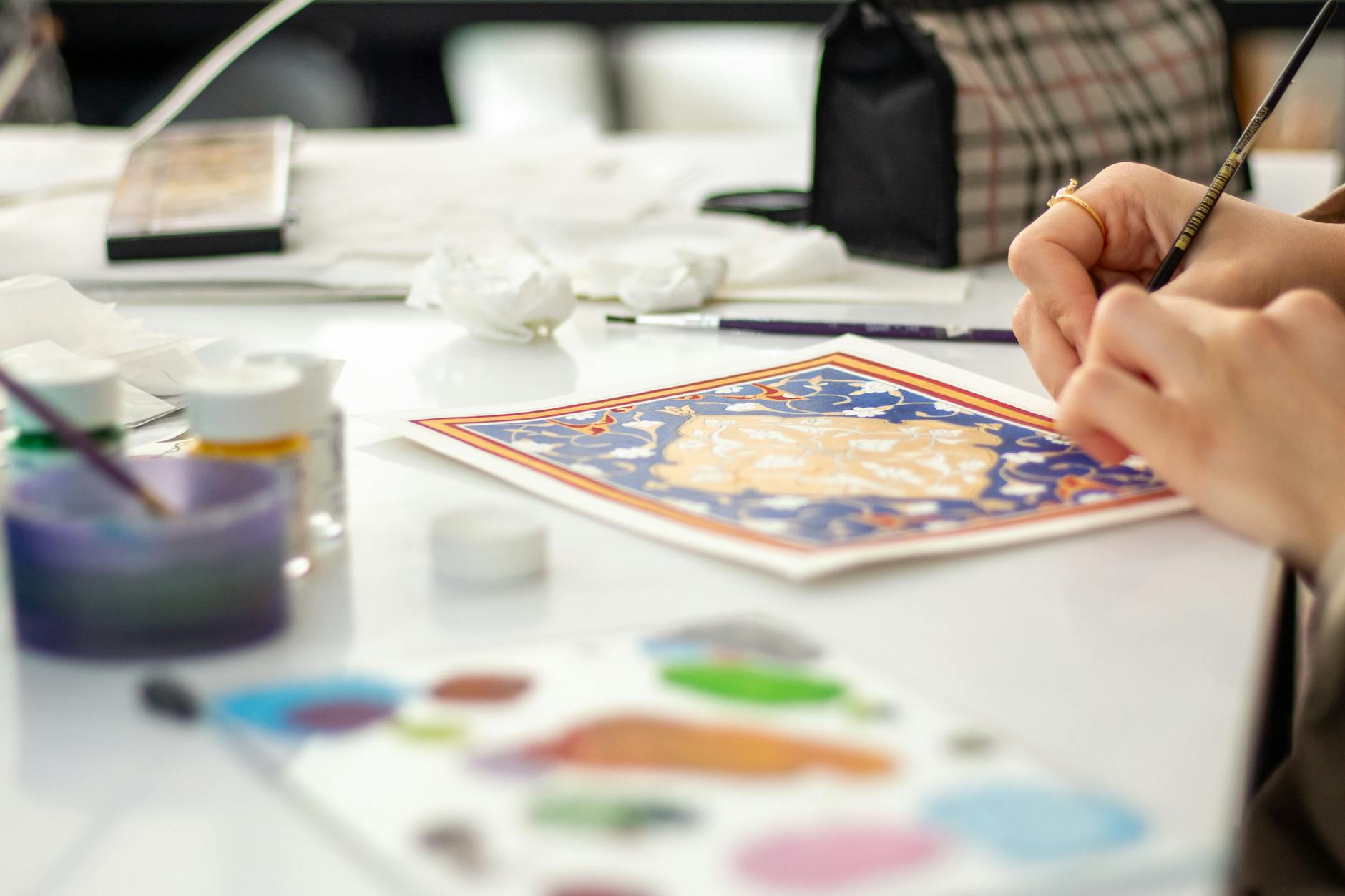
I recently had the joy of teaching an illuminated manuscripts workshop in collaboration with The Community Writing Center (CWC) in Salt Lake City. This class brought together history, poetry, and visual art during a meaningful moment for local creative organizations. Co‑taught with author and publisher Jonathan Reddoch of Collective Tales Publishing, the workshop invited participants to slow down, work by hand, and honor the arts as something worth illuminating!
Exploring the History of Illuminated Manuscripts
We began the workshop with a discussion of the history of illuminated manuscripts, looking at examples from medieval Europe that paired text with ornament, symbolism, and careful craftsmanship. Participants examined decorated initials, illustrated margins, and pages where writing and image were inseparable. These examples helped frame illuminated manuscripts not only as historical artifacts, but as reminders that words can be visually celebrated.
Starting with history gave everyone a shared reference point and encouraged thoughtful consideration of how meaning, decoration, and storytelling work together on the page.
Beginning with Poetry
Before moving into visual work, Jonathan led a short poetry session to help participants begin writing. Some drafted original poems, while others turned to favorite existing works that held personal significance. Focusing on language first reinforced the idea that illuminated manuscripts begin with writing, with words that carry intention and care.
This portion of the workshop created space for reflection, experimentation, and connection, especially for participants who may not regularly share their writing.
Designing Initials and Marginal Art
With poems selected or drafted, I guided the class as we moved into sketching illuminated initials and marginalia. Participants experimented with letterforms, decorative borders, symbols, and small illustrative elements inspired by the manuscript examples we had studied earlier. Sketching allowed everyone to explore composition freely and take creative risks before committing to final materials.
Each design reflected the writer’s voice, blending text and image in a way that felt personal.
From Sketch to Finished Page
Once sketches and poems were finalized, participants used transfer paper to move their designs onto watercolor paper. From there, pencil lines were traced with micron pens to set the structure of each piece. Color was added using watercolor, colored pencils, and markers, building depth and texture across the page.
To complete the illuminated effect, metallic gold and silver pens were used for final details. These reflective accents echoed historic techniques while giving each page a sense of intention and care.
Supporting The Community Writing Center
Teaching this workshop at the CWC fit perfectly into my experience. I’ve designed book covers, and have had both my art and written work published in local anthologies. My entire creative practice exists at the intersection of visual storytelling and written expression, which made illuminated manuscripts a natural format for this workshop.
This workshop took place during a period of transition for the CWC. Due to federal funding cuts that directly impacted their operations, the organization will be closing its current location at the Salt Lake Public Library this June. For many writers in Salt Lake City, this space has been an essential resource for learning, connection, and creative growth.
Supporting local organizations like this one is critical, especially when funding decisions have real consequences for access to arts education and community spaces. I will share more about the future of the CWC as it becomes available.
Interested in attending a future workshop? Come create with me!
xoxo,
Michaela Rae
